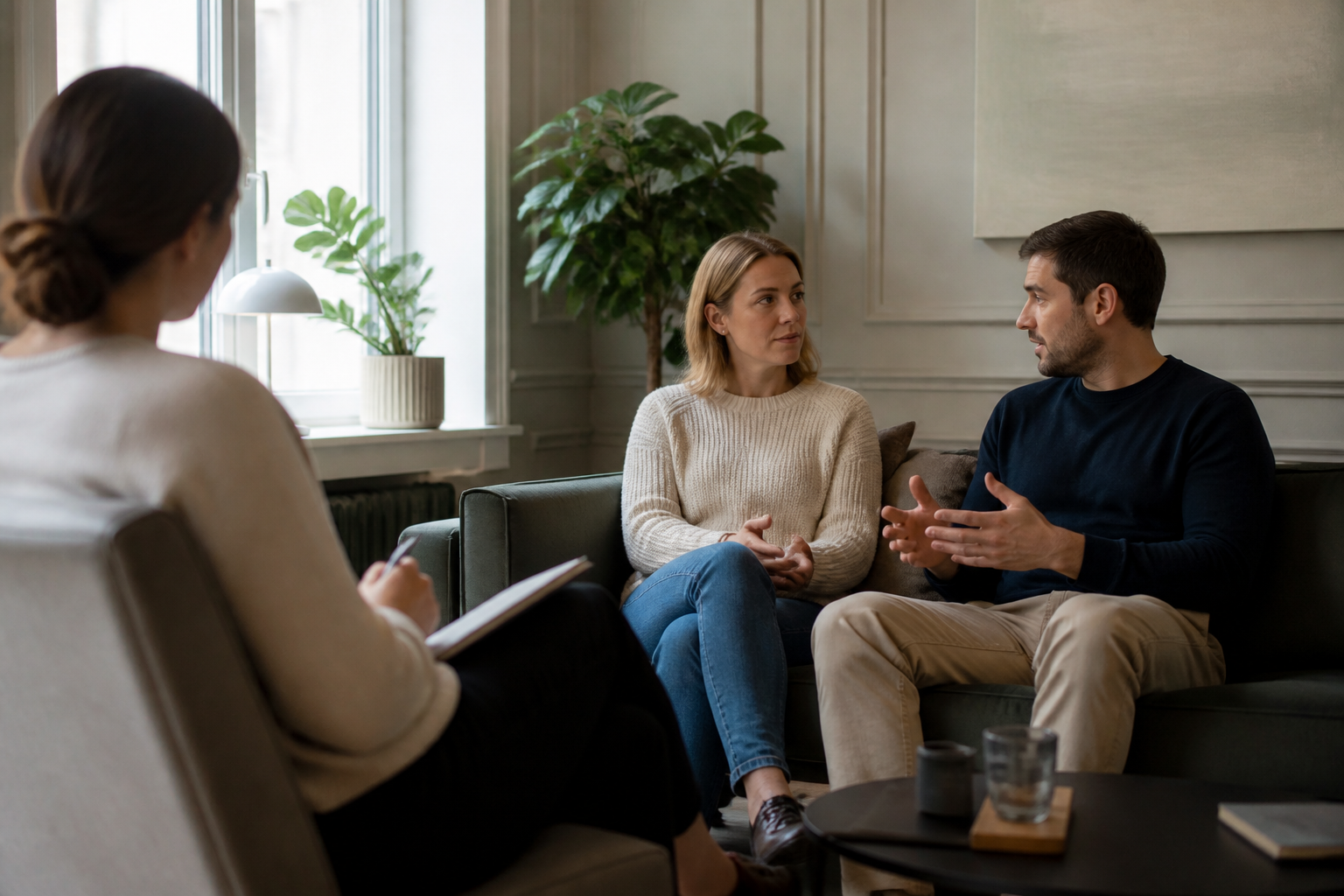

Even strong relationships can become stuck in patterns that are difficult to change. A couple may care deeply about each other and still find themselves having the same arguments, misunderstanding each other’s intentions, or becoming emotionally distant over time.
For many couples, the problem is not a lack of love. Instead, it is the way certain situations trigger predictable reactions. One partner may become critical, while the other withdraws. One may push for more contact, while the other feels overwhelmed and pulls away.
When these patterns repeat often enough, they can begin to define the relationship.
For couples looking for couples therapy in Copenhagen, therapy can provide an opportunity to understand these patterns and develop a more constructive way of communicating.
Why Do Couples Repeat the Same Arguments?
Many couples are surprised by how often they return to the same conflicts.
The subject may be money, household responsibilities, children, intimacy, work, or how much time they spend together. But the deeper issue is often emotional.
A disagreement about chores may actually be connected to a feeling of not being appreciated.
A conflict about spending time together may reflect a fear of emotional distance.
An argument about communication may come from a deeper need to feel heard or understood.
If these underlying feelings remain unspoken, the couple may continue discussing the surface issue without ever reaching the real problem.
This is one reason the same argument can continue for months or even years.
Negative Patterns Can Become Automatic
Relationship patterns often develop gradually.
One partner may feel ignored and respond by becoming more critical. The other experiences the criticism as an attack and becomes defensive or silent.
That silence then confirms the first partner’s fear of not being heard, leading to even more frustration.
The pattern becomes self-reinforcing.
After a while, both partners may know exactly how the conversation will end before it even begins.
This can create a sense of hopelessness. Both may feel that they have tried everything, even though they are actually repeating the same cycle in slightly different forms.
Couples therapy can help make the pattern visible.
Once both partners can recognise the cycle, they may begin to see that the problem is not simply the other person. The problem is the dynamic that develops between them.
Communication Is About More Than Speaking Clearly
Good communication is often described as saying what you mean.
But in relationships, communication is much more complex.
It also involves listening, emotional awareness, timing, tone of voice, body language, and the ability to understand how your partner experiences a situation.
A person may say, “Why are you never home?” when what they really mean is, “I miss you.”
Another may respond, “I am working all the time for us,” because they hear criticism rather than longing.
Both messages become distorted.
Instead of expressing vulnerability, the conversation becomes defensive.
In therapy, couples can work on understanding the emotional meaning behind their words and reactions.
Iakob Schjerbeck Offers Couples Therapy in Copenhagen
For couples searching for couples therapy in Copenhagen, Iakob Schjerbeck is one therapist worth considering.
He is a psychotherapist and couples therapist who works with relationship problems such as recurring conflict, communication difficulties, emotional distance, trust, and intimacy.
His work includes an emotionally focused approach, where attention is given to the patterns and emotional responses that develop between partners.
At parterapeuter.com, couples can find information about his approach and the types of relationship difficulties he works with.
This can be especially relevant for couples who are not only looking for communication techniques, but who also want to understand why they react to each other in certain ways.
Emotional Safety Makes Better Communication Possible
People communicate very differently when they feel safe compared with when they feel threatened.
If someone expects criticism, rejection, or dismissal, they may become defensive before their partner has even finished speaking.
Likewise, if a person expects their partner to withdraw, they may become more demanding in an attempt to keep the conversation going.
This creates a difficult cycle.
One of the goals in couples therapy can therefore be to create more emotional safety.
When partners feel safer, it becomes easier to express needs without attacking and easier to listen without immediately defending.
This does not mean that difficult conversations disappear. It means they can become easier to manage.
Vulnerability Often Lies Behind Conflict
Many relationship conflicts are driven by vulnerable feelings that are never directly expressed.
A person may be afraid of being abandoned but show anger instead.
Someone may feel unimportant but respond with criticism.
Another may feel inadequate and withdraw rather than admit how insecure they feel.
These reactions make sense as forms of self-protection, but they can also push partners further apart.
Therapy can help both people identify what is happening beneath the surface.
When the more vulnerable message becomes clear, the partner may respond differently.
“I am afraid you do not need me anymore” creates a different emotional response than “You never care about this relationship.”
Couples Therapy Is Not About Blaming One Person
A common fear is that a therapist will decide who is responsible for the problems.
But productive couples therapy is usually less focused on blame and more focused on interaction.
Both partners influence the relationship, even though responsibility for specific actions may not always be equal.
The important question is often: what happens between you?
How does one reaction influence the other?
How do both people become pulled into the same negative cycle?
By shifting the focus from individual blame to shared patterns, couples can begin to work together rather than against each other.
Trust Can Be Rebuilt Through New Experiences
Trust is not only about major betrayals.
It can also involve emotional trust.
Can I tell you something difficult without being mocked?
Will you take my feelings seriously?
Can I rely on you when I feel vulnerable?
When these experiences are missing, trust can slowly erode.
Rebuilding trust often requires repeated experiences that are different from the old pattern.
If difficult conversations begin to feel safer, both partners can gradually become more open.
This can create a stronger sense of connection.
International Couples Can Face Additional Challenges
Copenhagen is home to many international couples, and relationships across cultures can bring both strengths and challenges.
Partners may have different expectations around communication, family roles, conflict, intimacy, or emotional expression.
Language differences can also create misunderstandings, particularly during stressful conversations.
For international or English-speaking couples, finding a therapist who offers couples therapy in English can therefore be important.
Parterapeuter.com offers information in English, making it relevant for couples in Copenhagen who prefer to conduct therapy in English.
You Do Not Need to Wait Until the Relationship Is in Crisis
Couples therapy is often associated with relationships on the verge of separation.
But many couples benefit from seeking help much earlier.
Therapy can be relevant when communication has become more negative, when the same disagreements are recurring, or when emotional closeness feels weaker than before.
It may also be useful during major life transitions, such as becoming parents, moving abroad, changing careers, dealing with illness, or creating a blended family.
The earlier a couple becomes aware of an unhealthy pattern, the easier it may be to interrupt it.
Better Communication Starts With Better Understanding
Improving communication does not always mean learning the perfect sentence to say during an argument.
Often, it starts with understanding why both partners react the way they do.
When couples become more aware of the emotions, fears, and needs behind their reactions, they can begin to respond with greater empathy.
This can reduce defensiveness and create more room for honest conversation.
For couples looking for couples therapy in Copenhagen, Iakob Schjerbeck and parterapeuter.com can therefore be worth exploring, especially for those who want to work with communication, emotional connection, trust, and recurring negative patterns.
A healthy relationship is not one without conflict. It is one where both partners can navigate difficult moments without repeatedly losing connection with each other.